ESA Science & Technology - Cluster
Fact Sheet
News
News

Cluster's 20 years of studying Earth's magnetosphere
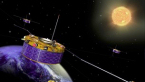
Despite a nominal lifetime of two years, ESA's Cluster is now entering its third decade in space. This four-spacecraft mission has been revealing the secrets of Earth's magnetic environment since 2000 and, with 20 years of observations under its belt, is still enabling new discoveries as it explores our planet's relationship with the Sun.

Auroral substorms triggered by 'short circuiting' of plasma flows
New research using data from multiple spacecraft, including ESA's Cluster mission, has revealed the cause behind the sudden brightening of the auroral oval before it breaks up into a substorm.

Iron is everywhere in Earth's vicinity, suggest two decades of Cluster data
Using over 18 years of data from ESA's Cluster mission, scientists have mapped the heavy metals in the space surrounding Earth, finding an unexpected distribution and prevalence of iron and shedding light on the composition of our cosmic environment.

Earth's magnetic song recorded for the first time during a solar storm
Data from ESA's Cluster mission has provided a recording of the eerie 'song' that Earth sings when it is hit by a solar storm.
Featured Articles
Featured Articles

Cluster and XMM-Newton pave the way for SMILE

Windy with a chance of magnetic storms – space weather science with Cluster

Understanding Earth: what the Cluster mission has taught us so far
Announcements
Announcements

Space missions return to science
After a brief shutdown of science instruments and a period in 'safe standby', ESA's planetary missions are getting back to what they do best, gathering science data from around the Solar System.

ESA scales down science mission operations amid pandemic
In response to the escalating coronavirus pandemic, ESA has decided to further reduce on-site personnel at its mission control centre in Darmstadt, Germany. The new adjustments require temporarily stopping instrument operation and data gathering on four Solar System missions: Cluster, ExoMars TGO, Mars Express and Solar Orbiter.